
What Reactive Dog Training Classes Can Help Your Dog Learn
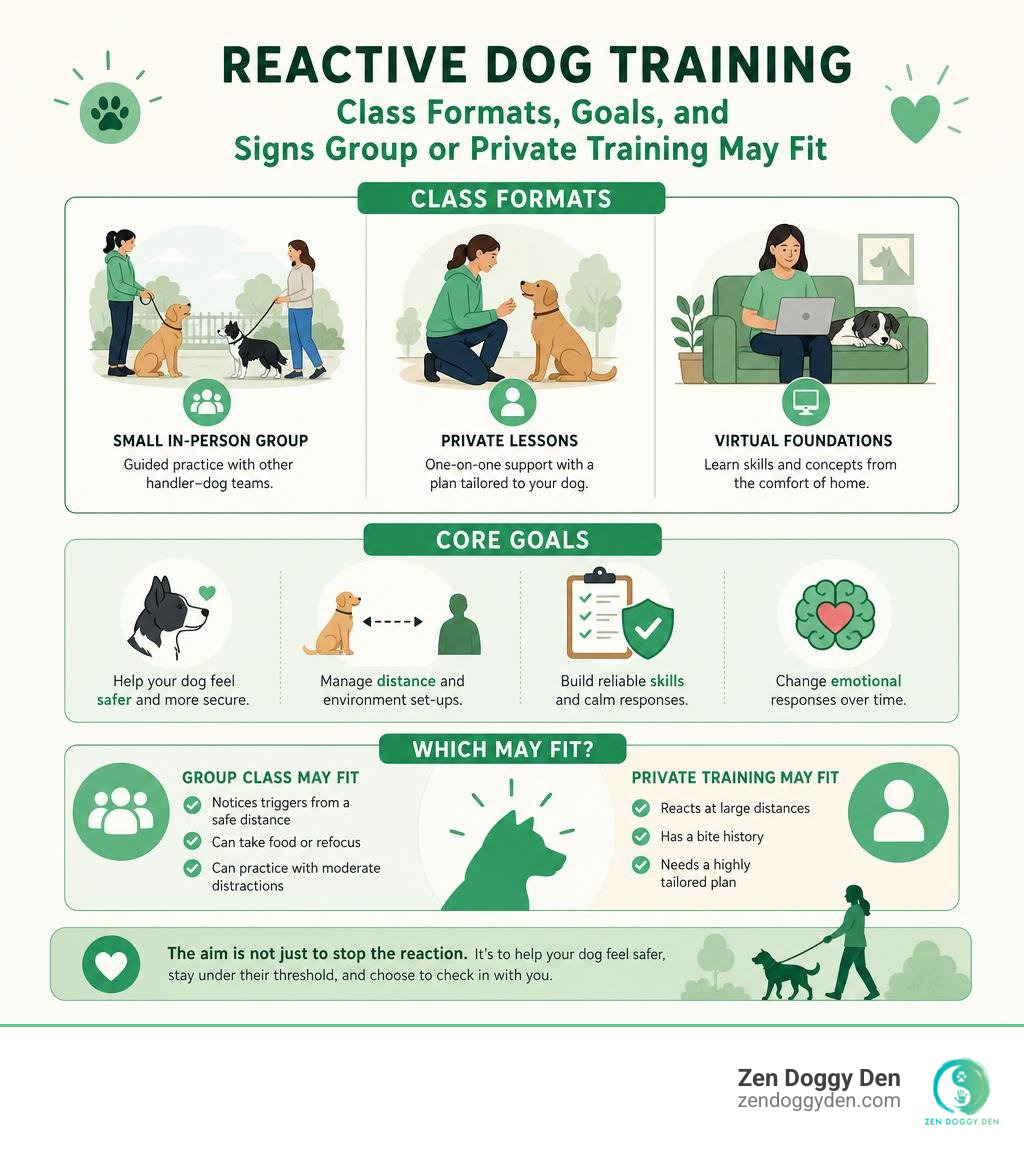
Reactive dog training classes help dogs that bark, lunge, growl, pull, or fixate on triggers such as other dogs, people, bikes, or squirrels. These behaviors are often linked to fear, frustration, stress, or overstimulation, not a dog being “bad.”
A good class gives you and your dog a controlled place to practice calmer responses. The aim is not simply to command your dog to sit while a trigger passes. It is to help them feel safer, stay below their emotional threshold, and gradually choose to check in with you instead of reacting.
| Quick answer | What it means |
|---|---|
| Best for | Dogs with leash barking, lunging, pulling, or intense staring |
| Common formats | Small in-person groups, private lessons, and virtual foundations |
| Core focus | Reading body language, managing distance, and changing emotional responses |
| Group-class fit | Dogs that can notice triggers from a safe distance and still take food or refocus |
| Private-training fit | Dogs that react at large distances, have a bite history, or need a highly tailored plan |
For a busy family, this work can make walks, school-drop-off hours, and visitors feel less like a daily crisis. It also gives everyone a clear plan, so progress does not rely on reacting in the moment.
I am Julie McLean, and I will help you understand what these classes involve before we look at causes, options, and readiness.
Understanding Dog Reactivity: Causes and Core Concepts
When a dog explodes on leash at the sight of another dog across the street, it is rarely an act of unprovoked malice. Reactivity is an exaggerated behavioral response to normal environmental stimuli. Common triggers include other dogs, bicycles, runners, delivery trucks, or strangers approaching on narrow sidewalks. For a broader veterinary overview of stress-related behavior concerns, the Merck Veterinary Manual guide to behavior problems in dogs offers helpful background on how behavior, environment, and health can interact.
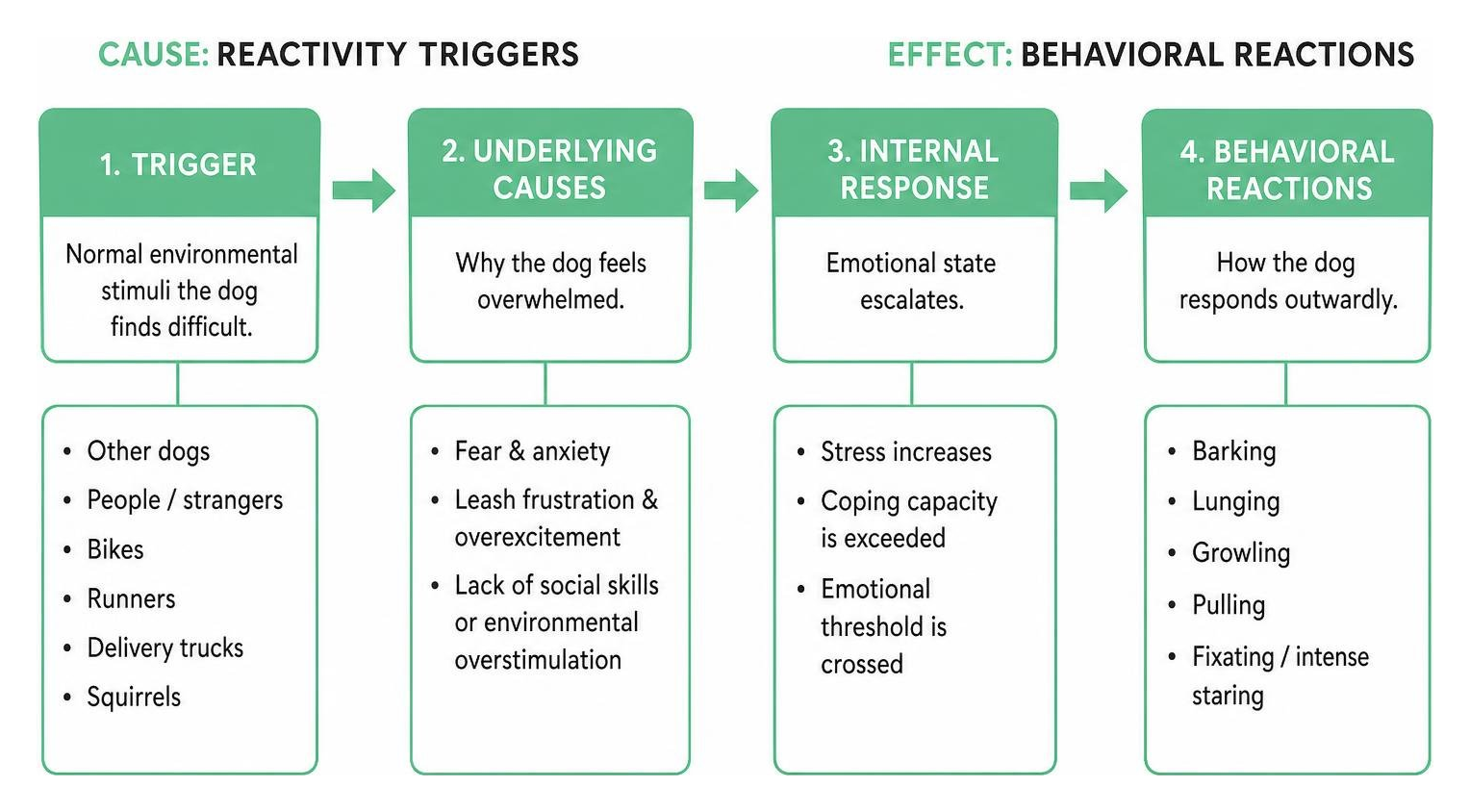
Understanding why your dog reacts is the first step toward lasting improvement. In our experience working with pet parents throughout Wheat Ridge, Denver, and Arvada, reactivity typically stems from three primary root causes:
- Fear and Anxiety: A vast majority of reactive dogs act out because they feel vulnerable. On a leash, a dog loses their natural “flight” option. When they cannot retreat, they resort to “fight” behaviors (barking, lunging, growling) to create distance between themselves and the scary object.
- Leash Frustration and Overexcitement: Some dogs love other dogs or people so much that being restricted by a tight leash creates massive frustration. This barrier frustration builds up until the dog vents their energy through high-pitched barking, pulling, and spinning.
- Lack of Social Skills or Environmental Overstimulation: Dogs raised without proper exposure to everyday sights during early development may struggle to process complex surroundings. In dense urban setups like the Denver Metro Area, constant close-proximity triggers can quickly exceed a dog’s coping capacity.
It is crucial to distinguish between underlying emotions and basic obedience. A dog who knows how to sit indoors may completely ignore commands when overstimulated outside. Reactive behavior is not simply a breach of manners; it is a manifestation of emotional overload. Through structured Training, we help handlers recognize stress signals before an outburst occurs, allowing the dog to build real social coping skills over time.
Choosing the Right Reactive Dog Training Classes
Not all reactive dog training classes are created equal. Finding the right format depends heavily on your dog’s current stress threshold, your schedule, and your family’s specific training goals. Programs typically range from structured 4 to 8-week courses, costing anywhere between $165 and $600 depending on hands-on involvement, location, and instructor expertise.
When choosing a program, consider how the course is delivered and what spatial safety controls are implemented.
Evaluating Group Reactive Dog Training Classes
Group classes designed specifically for reactive dogs look nothing like standard puppy obedience courses. In a quality group reactivity session, safety, distance control, and stress reduction are top priorities.
When evaluating a group class, look for these critical components:
- Strict Class Size Limits: Groups must be capped at 4 to 5 dogs maximum. Overcrowded classes make distance management impossible and lead to trigger stacking.
- Visual Barriers: Look for facilities that utilize physical screens, tall dividers, or X-pens covered with sheets. Barriers give dogs immediate visual relief between working repetitions.
- Aggression and Bite Screening: Reputable centers require thorough behavior questionnaires or pre-evaluations. Dogs with severe bite histories toward humans or dogs are usually routed into individual behavioral programs first for safety.
- Structured Class Design: Top programs often incorporate human-only orientation sessions or alternate weekly dog attendance so handlers learn handling mechanics without struggling to manage a stressed pet simultaneously.
If you are exploring regional formats, structured programs demonstrate how small cohorts and multi-level progressions help dogs transition from controlled indoor environments to real-world applications.
Virtual Workshops and Private Training Formats
Group classes are not the only, or always the best, starting point. Virtual options and 1-on-1 coaching offer distinct advantages depending on your dog’s needs:
- Virtual Foundations: Starting online allows handlers to learn timing, body language reading, and mechanics from the comfort of home. Through Virtual Dog Training, dogs build core focus cues without facing a single trigger. This ensures that when live distractions are introduced, both handler and dog already share a established vocabulary.
- Private Behavior Coaching: If your dog reacts at extreme distances or cannot function near other dogs, starting with customized Private Training is essential. One-on-one coaching allows us to tailor every repetition to your dog’s exact threshold, practicing in real neighborhood settings around Wheat Ridge or Lakewood.
Assessing Readiness: Is Your Dog Ready for Group Training?
Sending a highly stressed dog straight into an indoor facility full of other barking dogs can result in flooding, worsening the behavior rather than fixing it. Assessing your dog’s baseline readiness ensures you enroll in a setting where they can actually learn.
The 40-Foot Distance Rule and Treat Self-Test
To evaluate whether your dog is ready for a group reactive class, use the 40-Foot Rule and the Treat Focus Test on your next walk:
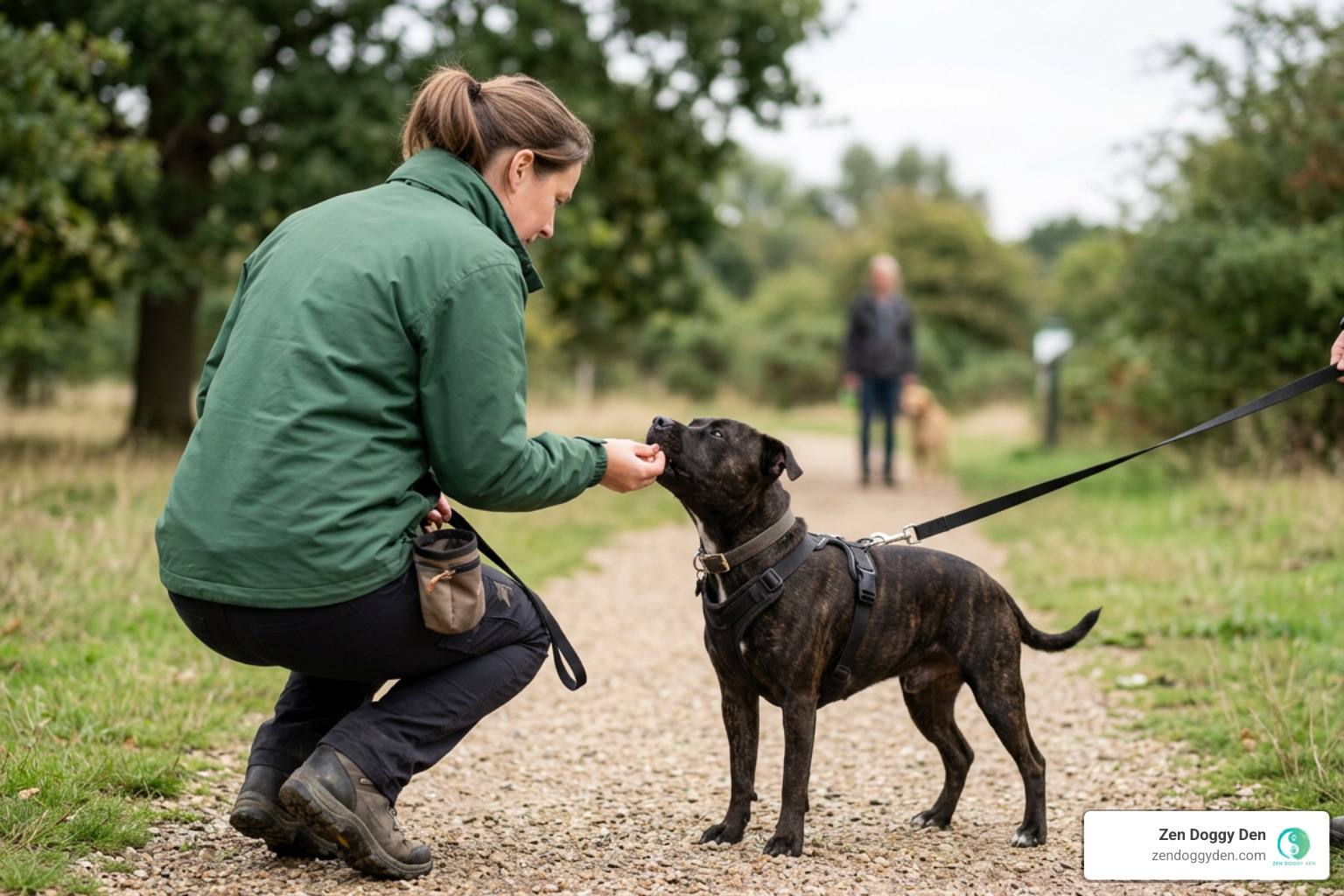
- The 40-Foot Threshold Benchmark: Observe your dog when another dog or person appears approximately 40 feet away (roughly the length of a standard four-car driveway). Can your dog look at the trigger without instantly fixating, barking, or lunging? If your dog can maintain composure at 40 feet, they are generally a strong candidate for small group classes. If they react at 100 feet or more, start with private lessons.
- The High-Value Treat Redirect Test: Carry high-value rewards (such as diced chicken, hot dogs, or string cheese) on a walk. When a trigger appears at a distance, call your dog’s name or mark their attention. If your dog turns to take the treat, their brain is still in a cognitive, learning state. If they refuse meat or cheese, they are over threshold and incapable of processing new skills in a group setting.
Preparing Handler and Dog Before Class
Preparing thoroughly before your first in-person session prevents unnecessary stress on class day:
- Priceless Handling Gear: Equip your dog with a well-fitted, comfortable harness (such as a front-clip or dual-clip harness) and a flat collar. Use a sturdy 4 to 6-foot fixed leash. Never use retractable leashes, as they lack precise control and present safety hazards.
- Muzzle Conditioning: If required or recommended, introduce a comfortable basket muzzle at home weeks in advance using positive association. Basket muzzles allow your dog to pant, drink, and eat treats freely while providing complete safety during transit.
- High-Value Food Hierarchy: Prepare a pouch of soft, pea-sized, ultra-delicious treats. Standard kibble rarely competes with the presence of environmental triggers.
- Settling Mat: Bring a familiar dog bed, mat, or towel. Teaching your dog a “place” cue gives them a designated, comfortable safe zone during rest periods.
- Attend Orientations: Complete any mandatory human-only orientation lectures or virtual prep modules before bringing your dog into class.
Proven Behavior Modification Methods and Essential Skills
Modifying reactive behavior relies on proven behavioral science, structured mechanics, and appropriate equipment management. In a professional setting, balanced handling combines clear boundaries, environmental control, and rewarding alternative behaviors.
| Technique | Goal | Practical Application |
|---|---|---|
| Habituation | Passive exposure until passive tolerance occurs | Dog rests far from a trigger without active engagement; works best in static environments. |
| Systematic Desensitization | Gradual exposure under emotional threshold | Presenting triggers at safe distances, slowly reducing distance as composure increases. |
| Counterconditioning | Changing the underlying emotional reaction | Pairing the sight of a scary trigger with high-value rewards or play. |
Structured reactive dog programs emphasize counterconditioning protocols to help handlers change how their dogs feel about potential triggers.
Changing Emotional Responses Through Desensitization
Rather than constantly commanding a fearful dog to sit or down while they tremble, the core aim of reactivity training is to shift their internal emotional state.
Through classical counterconditioning, the trigger (e.g., an approaching dog) acts as a predictor for something wonderful (e.g., real chicken or play). Over multiple controlled repetitions, the dog’s involuntary reaction shifts from “Oh no, a dog is coming, I need to drive it away!” to “Great, a dog is coming, good things happen to me!”
This work must take place under threshold. A threshold is the boundary line where a dog notices a trigger but remains calm enough to make conscious choices. If a dog crosses their threshold, their sympathetic nervous system takes over, making learning impossible until distance is re-established.
Essential Cues Taught in Reactive Dog Training Classes
During group or individual reactive training, you and your dog will master several critical skills:
- The “Find It” Game: Tossing a treat onto the ground while saying “Find it!” encourages the dog to lower their head, sniff, and disengage visually from a trigger. Sniffing naturally lowers heart rates.
- The Treat Magnet: Placing a treat directly at your dog’s nose and slowly guiding them past a mild distraction keeps their head focused on you while their body moves safely away.
- The Attention / “Look” Game: Teaching your dog to look at a trigger and then quickly look back at you for a reward (“Look at That” protocol).
- Emergency U-Turn: A quick, enthusiastic 180-degree turn cue used when a trigger suddenly rounds a corner without warning.
- Marker Timing: Handlers learn precise verbal markers (such as “Yes!”) or clicker mechanics to capture the exact split-second a dog chooses to disengage from a trigger.
Limitations of Group Settings and What To Do Next
While small group classes provide controlled distraction, they have distinct structural limitations. A common phenomenon reported by pet owners is setting-specific habituation. A dog may perform flawlessly by week four of a indoor group class because they have gotten used to the specific dogs, smell, and layout of that exact room.

However, habituation does not automatically equal generalized learning. When taken back out onto the sidewalks of Arvada or crowded trails near Boulder, the dog may resume barking at unknown dogs.
Why does this happen? Real-world environments are unpredictable. Sidewalks feature tight spatial bottlenecks, sudden blind corners, and erratic triggers like skateboards or loose pets.
To bridge this gap:
- Transition to real-world outdoor practice sessions after completing foundational indoor coursework.
- Practice skills in varying low-distraction environments (e.g., quiet park edges, open parking lots) before tackling busy streets.
- Consider supplemental care programs like Dog Day Training Services, where professional trainers work directly with your dog in various contexts to generalize calm behaviors.
Frequently Asked Questions About Dog Reactivity
Is dog reactivity the same as aggression?
No, reactivity and aggression are distinct behavioral categories, though an unmanaged reactive episode can escalate if handled improperly. Reactivity is an over-reaction to an environmental trigger, usually driven by fear, insecurity, barrier frustration, or excitement. Aggression is behavior specifically intended to cause harm or establish distance through biting and intimidation. Many leash-reactive dogs are completely friendly and social when interacting off-leash.
How long does it take to fix dog reactivity?
Behavior modification is a journey rather than an instant fix. Progress depends on how long the behavior has been rehearsed, the dog’s underlying temperament, and handler consistency. Minor leash frustration may show significant improvement within 4 to 8 weeks. Deeply ingrained, fear-based reactivity typically requires several months of consistent threshold management and ongoing skill reinforcement.
What equipment is prohibited in reactivity classes?
Training equipment selection depends on the class curriculum, safety requirements, and professional evaluation. In specialized reactivity classes, tools that increase panic or restrict physical control, such as long retractable (flexi) leashes, are widely prohibited due to safety hazards.
Professional handling emphasizes tools that provide security and clear communication, such as well-fitted front-clip harnesses, sturdy fixed leashes, head halters, or properly fitted basket muzzles. In an educated, professional setting, tools are chosen thoughtfully to maintain safety, maintain handler control, and keep stress levels manageable for the dog.
Take the Next Step Toward Calmer Walks
Living with a reactive dog can feel overwhelming, but you do not have to navigate walks in constant stress. Whether through small group sessions, virtual prep courses, or individualized behavioral plans, structured training equips you with the tools needed to restore calm to your daily outings.
At Zen Doggy Den in Wheat Ridge, CO, we support dogs across the Denver Metro Area, including Denver, Lakewood, Arvada, and Boulder. Our unique approach balances mental enrichment, structured physical exercise, and professional behavior handling to help your dog build genuine emotional regulation.
Ready to transform your walk from a daily stressor into an enjoyable experience? Visit our Dog Training Center today to explore our training programs and find the perfect path forward for you and your dog!